

3 months ago
The Constitution of Zambia is the supreme law of the land, providing the framework for the country's governance and the relationship between the government and its citizens. Adopted in 2016, the current constitution outlines the fundamental rights and freedoms of Zambians, as well as the structure and powers of the various branches of government. Understanding the constitution of Zambia is essential to grasping the complexities of the country's politics, laws, and social dynamics, making it a vital component of Zambia's democratic development and stability.

- Key Features of the Constitution of Zambia
-
Understanding the Framework: A Comprehensive Overview of the Constitution of Zambia
- What is the official PDF document of the Constitution of Zambia?
- Are there any updates or amendments to the Constitution of Zambia scheduled for 2024?
- Where can I find the PDF version of the Constitution of Zambia as amended up to 2022?
- What are the key provisions and changes introduced by the 1996 Constitution of Zambia?
- FAQ
Key Features of the Constitution of Zambia
The constitution of Zambia is the supreme law of the land, providing the framework for the governance of the country. It outlines the powers and functions of the various branches of government, as well as the fundamental rights and freedoms of citizens. The constitution has undergone several amendments since its adoption in 1991, with significant revisions made in 2016.
Historical Background of the Constitution of Zambia
The constitution of Zambia has its roots in the country's struggle for independence from British colonial rule. The first constitution was adopted in 1964, upon gaining independence. Since then, the constitution has undergone several transformations, with the most significant being the 1991 constitution, which introduced multiparty democracy. The 2016 amendment brought about significant changes, including the introduction of a bill of rights and provisions for the protection of the environment.
Structure of the Constitution of Zambia
The constitution of Zambia is divided into several chapters, each addressing different aspects of governance and citizens' rights. The chapters cover topics such as the bill of rights, the executive, the legislature, and the judiciary. The constitution also establishes the framework for the administration of justice, the protection of human rights, and the promotion of good governance.
Fundamental Rights and Freedoms
The constitution of Zambia guarantees fundamental rights and freedoms to citizens, including the right to life, liberty, and security of the person. It also protects citizens from discrimination on the grounds of race, sex, religion, and political opinion. The constitution further provides for the protection of human rights, including the right to a fair trial, freedom of expression, and freedom of assembly.
Amendments to the Constitution of Zambia
The constitution of Zambia provides for a process of amendment, which involves a national referendum. The 2016 amendment was a significant milestone in the country's constitutional history, as it introduced several progressive provisions. The amendment process is designed to be rigorous, ensuring that any changes to the constitution are carefully considered and widely supported.
Implementation and Challenges
Despite the progressive provisions of the constitution of Zambia, its implementation has faced several challenges. These include capacity constraints within government institutions, limited resources, and competing priorities. Efforts to address these challenges are ongoing, with a focus on strengthening institutions and promoting a culture of constitutionalism.
| Year | Significant Events |
|---|---|
| 1964 | Zambia gains independence with its first constitution |
| 1991 | Adoption of a new constitution introducing multiparty democracy |
| 2016 | Amendment to the constitution of Zambia, introducing a bill of rights and other significant changes |
Understanding the Framework: A Comprehensive Overview of the Constitution of Zambia
What is the official PDF document of the Constitution of Zambia?

The official PDF document of the Constitution of Zambia is a digital representation of the country's foundational legal document. The Constitution of Zambia outlines the framework of the government, the relationship between the government and its citizens, and the fundamental rights and freedoms of individuals.
History of the Constitution
The Constitution of Zambia has undergone several revisions since the country gained independence in 1964. The current constitution, which is available in PDF format, reflects the amendments and changes made over the years to ensure it remains relevant to the needs of the Zambian people. The document is considered a cornerstone of the country's legal system, providing a basis for governance and the rule of law. Key aspects of the constitution of zambia include the separation of powers, the protection of human rights, and the promotion of democratic principles.
| Year | Event | Description |
|---|---|---|
| 1964 | Independence | Zambia gained independence from British colonial rule. |
| 1991 | Constitutional Amendments | Significant amendments were made to the constitution to introduce multiparty democracy. |
| 2016 | Constitutional Review | A comprehensive review of the constitution was undertaken to address contemporary issues. |
Content and Structure
The official PDF document of the Constitution of Zambia is structured into various parts and chapters, each addressing different aspects of governance and the legal framework. It includes provisions related to citizenship, the bill of rights, the executive, legislative, and judicial branches of government, and the procedures for amending the constitution. The document is designed to be accessible, allowing citizens and stakeholders to understand their rights and the functioning of the government.
| Chapter | Content | Relevance |
|---|---|---|
| I | Preamble and Fundamental Principles | Sets out the foundational principles and objectives of the constitution. |
| II | Citizenship | Defines the criteria and procedures for acquiring Zambian citizenship. |
| III | Bill of Rights | Enumerates the fundamental rights and freedoms of individuals. |
Accessibility and Use
The availability of the Constitution of Zambia in PDF format enhances its accessibility, allowing a wider audience to access and review the document. This digital version is particularly useful for legal practitioners, researchers, and the general public who seek to understand the legal and governance framework of Zambia. The digital format facilitates easy dissemination and reference to the constitution, promoting transparency and awareness of the country's legal foundations.
| User Group | Use Case | Benefit |
|---|---|---|
| Lawyers and Judges | Reference in legal proceedings | Enhances the application of the law based on the constitution. |
| Researchers and Academics | Analysis and study | Facilitates a deeper understanding of Zambia's legal and political framework. |
| Citizens | Awareness and education | Promotes understanding of rights and responsibilities. |
Are there any updates or amendments to the Constitution of Zambia scheduled for 2024?

As of the latest available information, there have been ongoing discussions and proposals regarding potential updates or amendments to the constitution of Zambia. However, there is no definitive confirmation on whether any such changes are scheduled for 2024. The process of amending the constitution is complex and involves various stakeholders, including the government, civil society, and the general public.
Background on Constitutional Amendments
The constitution of Zambia has undergone several amendments since its adoption in 1991, with significant changes aimed at enhancing democratic governance and protecting human rights. Any future amendments would likely follow a similar rigorous process, involving public consultations, parliamentary approval, and potentially, a national referendum. The proposed changes could address various issues, including electoral reforms, the structure of government, and the protection of individual rights.
| Year | Amendment/Update | Status |
| 2016 | Constitutional Amendment Bill | Passed |
| 2020 | Proposed Electoral Reforms | Pending |
| 2024 | Potential Updates | Speculative |
Stakeholders Involved in the Amendment Process
The process of amending the constitution of Zambia involves a wide range of stakeholders. These include government officials, members of parliament, civil society organizations, and the general public. Each of these stakeholders plays a crucial role in shaping the proposed amendments through their input and feedback. Civil society organizations, in particular, are often at the forefront of advocating for specific changes, such as enhanced electoral transparency and strengthened checks on executive power.
| Stakeholder | Role |
|---|---|
| Government Officials | Proposing and drafting amendments |
| Civil Society Organizations | Advocating for specific changes and engaging in public awareness campaigns |
| Members of Parliament | Debating and voting on proposed amendments |
| General Public | Providing input through consultations and potentially voting in a referendum |
Potential Implications of Constitutional Amendments
Any amendments to the constitution of Zambia in 2024 or beyond could have significant implications for the country's governance and legal framework. For instance, changes aimed at enhancing electoral integrity could lead to more credible and transparent elections. Similarly, amendments focused on strengthening judicial independence and human rights protections could contribute to a more just and equitable society. However, the actual impact would depend on the nature of the amendments and how they are implemented.
| Potential Amendment | Possible Impact |
|---|---|
| Electoral Reforms | More transparent and credible elections |
| Strengthening Judicial Independence | Enhanced rule of law and protection of rights |
| Human Rights Protections | Greater safeguards for individual freedoms and social justice |
Where can I find the PDF version of the Constitution of Zambia as amended up to 2022?
The PDF version of the Constitution of Zambia as amended up to 2022 can be found through various online sources. Government websites and official gazettes often host the most updated versions of a country's constitution.
Official Government Sources
To obtain an authentic and updated version of the constitution of Zambia, one should first check the official government websites. The website of the Zambian Government or the National Assembly of Zambia may have a section dedicated to the constitution, where the PDF version as amended up to 2022 can be downloaded. These sources are considered reliable as they are directly affiliated with the government.
| Source | Description | Reliability |
|---|---|---|
| National Assembly of Zambia Website | Official government website that may host the constitution | High |
| Zambian Government Website | Main government portal that could have the constitution available | High |
Legal and Academic Databases
Another avenue to find the PDF version of the constitution of Zambia is through legal and academic databases. These databases often compile legal documents, including constitutions, for various countries. Legal research platforms and academic databases like JSTOR or Google Scholar might have the constitution available, either for free or through subscription.
| Database | Type | Access |
|---|---|---|
| JSTOR | Academic | Subscription-based |
| Google Scholar | Academic | Free |
| LexisNexis | Legal | Subscription-based |
International Law Repositories
International law repositories and organizations that focus on constitutional law may also host the constitution of Zambia. The Constitute Project or the International Constitutional Law website are examples of such repositories. They often provide constitutions in various formats, including PDF, and may have translations available.
| Repository | Description | Language Options |
|---|---|---|
| Constitute Project | A database of constitutions from around the world | Multiple |
| International Constitutional Law | Provides access to constitutional documents | Multiple |
What are the key provisions and changes introduced by the 1996 Constitution of Zambia?
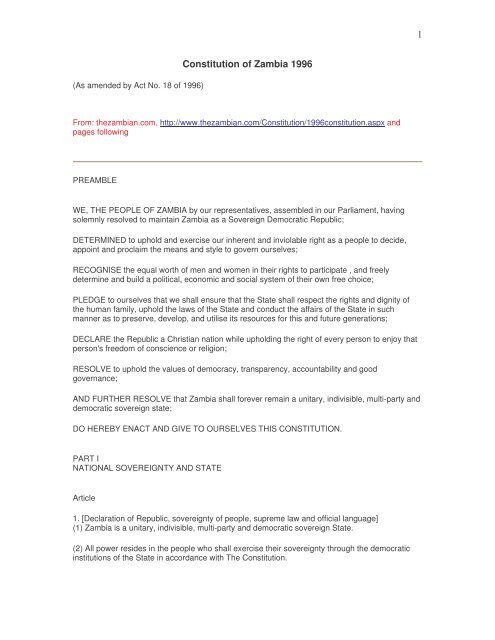
The 1996 Constitution of Zambia introduced significant changes to the country's governance structure and human rights provisions. The constitution of zambia enshrined the principles of democracy, human rights, and the rule of law. It established a presidential system of government, with a president serving as both head of state and head of government. The constitution also provided for a multi-party system, allowing for the existence of opposition parties.
Bill of Rights
The 1996 Constitution of Zambia incorporated a Bill of Rights, which protected fundamental human rights and freedoms, including the right to life, liberty, and security of the person. The Bill of Rights also prohibited discrimination on grounds such as race, sex, and religion. The constitution guaranteed the protection of individual rights and freedoms, and provided for the establishment of a Human Rights Commission to promote and protect human rights.
| Rights | Description |
|---|---|
| Right to Life | Protection against arbitrary deprivation of life |
| Right to Liberty | Protection against arbitrary detention |
Separation of Powers
The 1996 Constitution of Zambia provided for the separation of powers between the executive, legislative, and judicial branches of government. The constitution established a system of checks and balances, ensuring that no single branch of government could dominate the others. The judiciary was given the power to interpret the constitution and ensure that the other branches of government acted in accordance with its provisions.
| Branch of Government | Key Functions |
|---|---|
| Executive | Headed by the President, responsible for executing laws |
| Legislative | Responsible for making laws, comprising the National Assembly |
| Judiciary | Interprets laws and ensures constitutionality |
Amendment Procedures
The 1996 Constitution of Zambia established a process for amending the constitution, which required a two-thirds majority in the National Assembly and approval by the President. The constitution also provided for a referendum to be held in certain circumstances, such as when the proposed amendments affected fundamental provisions. The amendment procedures ensured that changes to the constitution of zambia were made in a deliberate and considered manner.
| Amendment Stage | Requirements |
|---|---|
| Proposal | Introduced in the National Assembly |
| Approval | Two-thirds majority in the National Assembly |
| Assent | Approval by the President |
FAQ
What is the Constitution of Zambia?
The Constitution of Zambia is the supreme law of the country, outlining the fundamental principles, structures, and powers of the government, as well as the rights and freedoms of its citizens. It serves as the foundation of the Zambian legal system and provides a framework for governance. The Constitution has undergone several revisions since the country's independence in 1964, with significant amendments aimed at strengthening democratic principles and human rights.
When was the current Constitution adopted?
The current Constitution of Zambia was adopted in 2016, following a lengthy process of review and consultation. This new Constitution introduced several key changes, including the enhancement of executive powers, the strengthening of parliamentary oversight, and the entrenchment of human rights and freedoms. The adoption of the new Constitution marked an important milestone in Zambia's democratic journey.
What are the key features of the Constitution?
The Constitution of Zambia has several key features, including the establishment of a presidential system of government, a multi-party democracy, and a bill of rights. It also provides for the separation of powers among the executive, legislature, and judiciary, ensuring a system of checks and balances. Additionally, the Constitution enshrines the principles of transparency, accountability, and good governance.
How can the Constitution be amended?
The Constitution of Zambia outlines a specific process for its amendment, which involves a national referendum for certain provisions and a parliamentary vote for others. Amendments to certain entrenched provisions, such as those related to fundamental rights and freedoms, require a referendum in which a majority of voters approve the changes. This ensures that any amendments to the Constitution are subject to broad public support and scrutiny.